Choosing a Smart Power Supply for global sourcing requires more than comparing wattage and price. Buyers must examine voltage ranges, connector standards, efficiency ratings, safety certifications, and supplier consistency. A unit that performs well in one market may fail when exposed to different grids, climates, or installation practices.
Real sourcing experience shows that small details often create expensive delays. A compact adapter may overheat inside a sealed cabinet. A loose connector may interrupt production after months of vibration. Reliable suppliers should provide test reports, traceable components, clear warranty terms, and samples from the intended production batch. Ask for evidence, not promises. Check thermal performance, standby consumption, surge protection, and electromagnetic compatibility before approving a large order.
The best Smart Power Supply supports both technical requirements and supply-chain stability. It should fit regional voltage conditions without complicated modifications. Its documentation should help technicians install and service it safely. Independent laboratory testing can strengthen confidence, although certifications alone never guarantee perfect field performance. That point deserves reflection. Even a carefully selected product can encounter unexpected loads, transport damage, or poor installation. A practical evaluation should include pilot testing, supplier audits, and realistic operating conditions. Leave room for improvement. Global sourcing rewards careful questions, transparent communication, and decisions based on verified performance rather than attractive specifications.
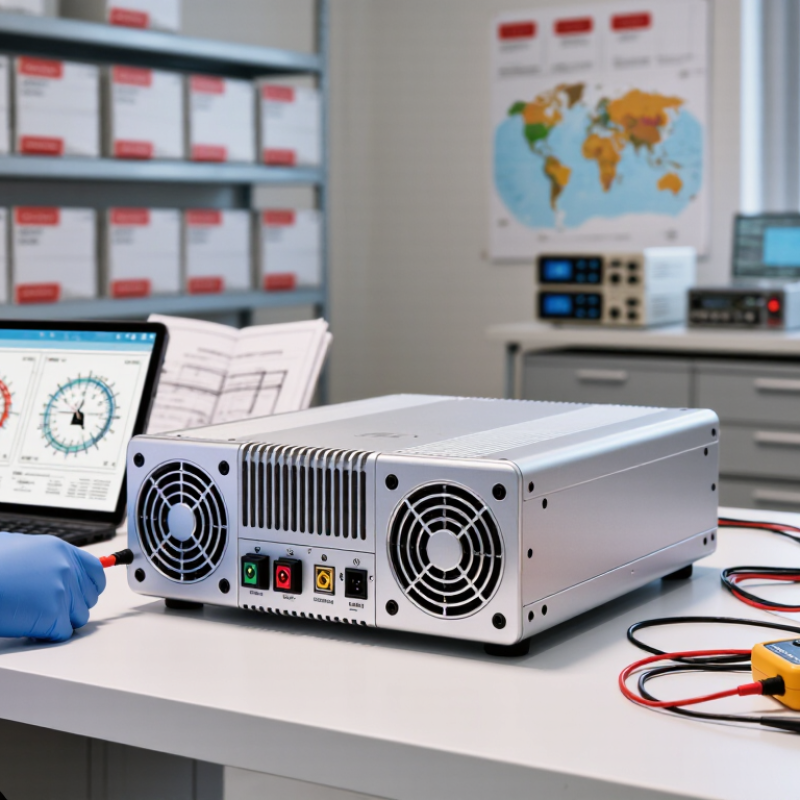
A smart power supply begins with the destination, not the product catalogue. For global sourcing, specify an input range of 100–240 V and 50/60 Hz. This supports common utility systems across North America, Europe, and Asia. However, the label alone proves little. I check the datasheet, input tolerance, inrush current, connector layout, and protection functions before requesting samples. Small details matter. A unit may accept worldwide voltage but still need a region-specific plug, fuse, or approval.
Efficiency deserves equal attention. The 80 PLUS testing framework measures performance at different loads, commonly 20%, 50%, and 100%. Higher certification levels can reduce wasted energy and heat, but only when the supply operates near its intended load. Oversizing is not automatically smarter. The IEA’s Electricity 2024 report estimates data-centre electricity demand could exceed 1,000 TWh by 2026, making conversion losses increasingly important. For office devices, industrial controls, or compact servers, compare typical-load efficiency rather than chasing a label alone.
During supplier audits, I request independent test reports, factory traceability, and evidence of compliance with applicable safety standards, such as IEC 62368-1. I also test units at low and high line voltage, with real cables and realistic loads. A perfect spreadsheet can still miss fan noise or unstable startup. That gap needs attention. Suppliers should state efficiency conditions clearly, because “up to” claims can hide weak performance at everyday loads.
| Requirement Dimension | Recommended Specification | Verified Technical Data | Why It Matters for Global Sourcing | Buyer Verification Method | ||||||||||||||||||||||||||||
|---|---|---|---|---|---|---|---|---|---|---|---|---|---|---|---|---|---|---|---|---|---|---|---|---|---|---|---|---|---|---|---|---|
| AC Input Voltage | 100–240 V AC, automatic switching | A universal-input power supply is designed to operate across the nominal voltage ranges used in many regions, including approximately 100–127 V and 220–240 V systems. | Reduces the need for separate regional versions and helps prevent incorrect manual voltage-selector settings. | Check the product label, datasheet, safety report, and test sample for the stated input range and automatic input selection. | ||||||||||||||||||||||||||||
| Input Frequency | 50/60 Hz | Most commercial AC grids operate at either 50 Hz or 60 Hz; a globally oriented supply should support both frequencies without a manual switch. | Supports deployment across markets with different grid frequencies. | Confirm “50/60 Hz” on the nameplate and validate operation during functional testing at both frequencies when required. | ||||||||||||||||||||||||||||
| Rated Output Power | Select based on measured maximum load plus 20–30% headroom | For a measured 400 W maximum system load, a practical target is approximately 480–520 W, subject to the equipment’s transient and upgrade requirements. | Headroom helps accommodate startup demand, component aging, temperature derating, and future configuration changes. | Measure continuous and peak load with a calibrated power analyzer; do not size from nominal component wattage alone. | ||||||||||||||||||||||||||||
| 80 PLUS Efficiency Level | Gold or higher for equipment operating many hours per day | For 115 V internal power supplies, the common 80 PLUS Gold threshold is 87% efficiency at 20% load, 90% at 50% load, and 87% at 100% load. | Higher efficiency generally reduces wasted energy and heat, which can lower operating and cooling costs. | Verify the exact certification level, test voltage, load points, certificate scope, and model number in the certification database or test report. | ||||||||||||||||||||||||||||
| Efficiency Comparison | Use the level that matches duty cycle and cost targets |
Typical 115 V internal power-supply certification thresholds; verify the applicable certification version and input-voltage category.
|
Provides a standardized way to compare energy performance at defined load points. | Treat certification as one data point; also request efficiency curves at the actual operating load. | ||||||||||||||||||||||||||||
| Power Factor | Active power-factor correction, typically at least 0.90 at rated load | Active PFC reduces the phase displacement and waveform distortion associated with many switched-mode power supplies. | Can improve electrical infrastructure utilization and support compliance with regional requirements. | Request power-factor test results at 25%, 50%, 75%, and 100% load where available. | ||||||||||||||||||||||||||||
| Protection Functions | Over-voltage, under-voltage, over-current, short-circuit, over-temperature, and over-power protection | These protection functions are commonly used to disconnect or limit output during abnormal electrical or thermal conditions. | Helps reduce the risk of damage to the supply and connected equipment. | Review the protection list, trigger limits, recovery behavior, and laboratory test evidence. | ||||||||||||||||||||||||||||
| Regional Compliance | Applicable electrical safety, EMC, and environmental documentation | Market access may require conformity documentation covering electrical safety, electromagnetic compatibility, restricted substances, and energy-related requirements. | Prevents customs, installation, or marketplace delays caused by incomplete documentation. | Confirm that reports identify the exact product revision, rated input range, applicable standards, and validity period. | ||||||||||||||||||||||||||||
| Operating Temperature and Derating | Specify the required ambient temperature range and output derating curve | Power supplies may deliver less than their maximum rated output at elevated ambient temperatures, depending on design and cooling conditions. | Important for hot climates, enclosed cabinets, high-density installations, and continuous operation. | Request the thermal specification, fan-control behavior, derating graph, and full-load temperature test results. |
Note: Efficiency figures shown are commonly referenced 80 PLUS thresholds for 115 V internal power supplies at specified load points. Always confirm the current certification requirements and the exact input-voltage category applicable to the selected product.
Choose 100–240 V and 50/60 Hz for common utility systems worldwide. A region-specific plug, fuse, or approval may still be necessary. Check the datasheet, not only the label.
No. Input tolerance, inrush current, connectors, protection functions, and local approvals also matter. Small details matter. A suitable sample can still fail regional requirements.
Compare efficiency at typical loads, especially around 20%, 50%, and 100%. A higher certification level can reduce heat and wasted energy. Oversizing is not automatically better.
Request independent test reports, factory traceability, safety records, and material declarations. Match every document to the final production design. Old reports can mislead.
It addresses electrical, thermal, fire, and energy-related hazards in information technology equipment. Confirm the report matches the enclosure, input range, and intended use.
Review the Declaration of Conformity, technical files, risk assessments, emissions testing, and restricted-substance evidence. Check cables, solder, plastics, and internal components. Component changes can matter.
No. The device, cable, and charger must support the required power level. Test laptops and monitors under sustained loads. The cable may become the limit.
Test several devices at low and high input voltage with realistic cables and loads. Check overheating, overcurrent, short-circuit protection, startup stability, and fan noise. Laboratory results are not everything.
Exact maximum ratings may perform poorly in hot warehouses or crowded travel bags. Leave practical headroom for temperature and cable variation. I underestimated this once.
Choosing a Smart Power Supply for global sourcing requires a balance of technical performance, compliance, control features, and supply-chain reliability. Start by confirming compatibility with 100–240 V input and 50/60 Hz frequency, then evaluate energy performance through recognized 80 PLUS ratings. An 80 PLUS Gold design should achieve at least 90% efficiency at 50% load, helping reduce energy waste, operating costs, and heat generation.
Global compliance is equally important. Verify alignment with IEC 62368-1 safety requirements, CE and FCC obligations, and RoHS material restrictions for the target markets. Smart control should also be assessed, including USB-C PD 3.1 support for power delivery up to 240 W where applicable. Finally, compare MTBF, warranty coverage, minimum order quantity, production lead time, and total cost of ownership. A thorough evaluation of these factors helps buyers select a dependable, efficient, and scalable power solution for international procurement.

 Veltok Power